How can you effectively support your child's creativity and brain development? This article explores the importance of child-led play in fostering independent thinking beyond the limitations of rote learning. Discover practical parenting tips to unlock your child's potential and empower them to thrive as future leaders.

Is Your Child Truly Developing Independent Thinking Skills?
Many parents today feel a sense of pride as their children rapidly absorb information and expand their knowledge base. The speed at which kids pick up numbers, language, and scientific facts can be astounding. However, a common concern often arises: beyond this absorbed knowledge, is our child truly developing the ability to flexibly think and independently solve problems when faced with new situations? Are they just learning what's taught, or are they cultivating the power to think for themselves and create? To help children reach their full potential, we need an approach that goes beyond mere information acquisition.

Why 'How' Your Child Experiences the World Shapes Brain Development
A child's brain is far more than just a storage unit for facts. It's an active organ that forms and reorganizes complex neural circuits through interaction with the outside world, direct physical experiences, and navigating various relationships. If a child primarily engages in passive information reception, their brain may become accustomed only to given patterns, hindering the development of flexible responses to novel situations. It's like only ever walking on predefined paths; when an unexpected fork in the road appears, the ability to find one's own way becomes underdeveloped. The quality of these early experiences critically influences the trajectory of a child's brain development. This means how a child explores and understands the world is far more significant than how much they simply know.
※ This post contains affiliate links. I may earn a commission at no extra cost to you.


Igniting the Thinking Brain Through Child-Led Play
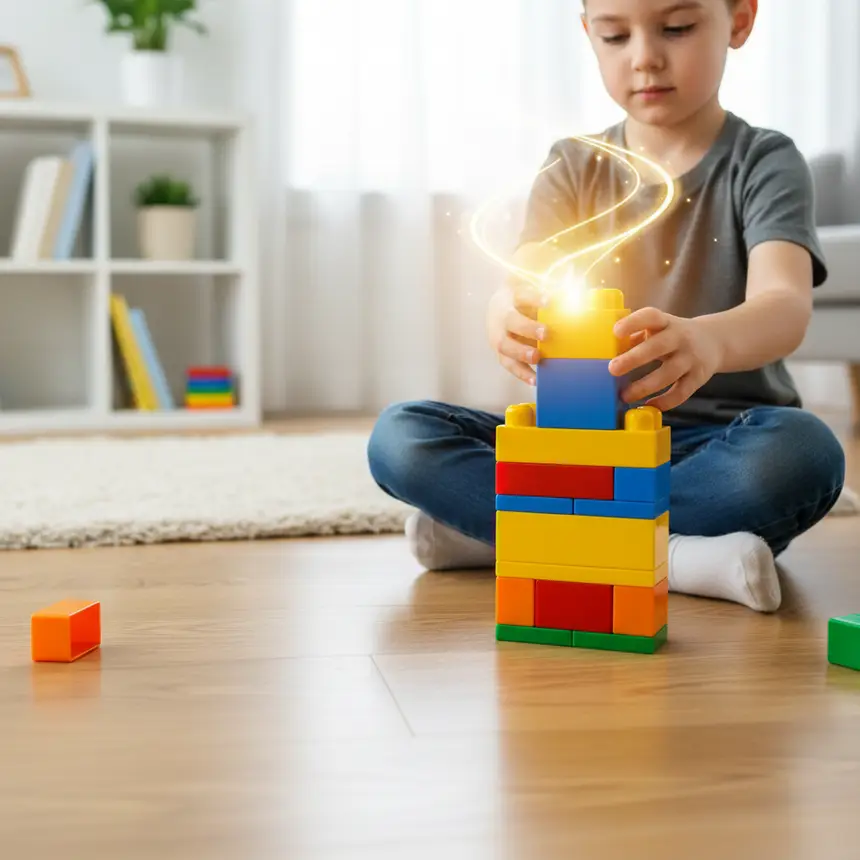
This brings us to a crucial element for fostering creativity and brain development in early childhood: child-led play. Child-led play encompasses all activities where a child actively participates by choosing and regulating the play's theme, methods, and rules. Unlike activities with predetermined answers or instructions, child-led play empowers children to develop key abilities such as:
- Cognitive Flexibility: Children explore various solutions when faced with new scenarios and try different approaches even after initial attempts fail, broadening their scope of thought.
- Problem-Solving Skills: By resolving conflicts or obstacles that arise within their play, children naturally acquire logical thinking and problem-solving strategies.
- Focus and Self-Regulation: Engaging deeply in self-chosen activities and managing impulses to achieve their play goals enhances their concentration and self-regulatory capacities.

Practical Ways to Nurture Your Child's Thinking Power Daily
There are several practical strategies parents can implement at home to support their child's self-directed learning and growth.
1. Offer Diverse Exploration Opportunities: Instead of solely focusing on specific toys, provide ample open-ended materials like blocks, clay, or natural items that children can freely transform and use imaginatively. This increases opportunities for them to explore and experiment in their unique ways.
2. Empower Choice: Respect your child's choices in daily life. Allowing them to decide small things, such as what to wear or which game to play first, is a crucial step in developing autonomy and problem-solving skills.
3. Praise and Encourage the Process: Focus on praising and encouraging the effort to solve problems and the originality of new ideas, rather than just the outcome. Instead of "You got the right answer!" try "How did you come up with that idea? That's amazing!" — acknowledging their thought process is key.
4. Encourage Ample Physical Activity: Moving the body, sensing, and experiencing are fundamental to cognitive development. Support your child in having plenty of experiences where they can explore and regulate their world through physical play, dancing, or simple games. Through this, they learn cognitive flexibility by trial and error.
1. Offer Diverse Exploration Opportunities: Instead of solely focusing on specific toys, provide ample open-ended materials like blocks, clay, or natural items that children can freely transform and use imaginatively. This increases opportunities for them to explore and experiment in their unique ways.
2. Empower Choice: Respect your child's choices in daily life. Allowing them to decide small things, such as what to wear or which game to play first, is a crucial step in developing autonomy and problem-solving skills.
3. Praise and Encourage the Process: Focus on praising and encouraging the effort to solve problems and the originality of new ideas, rather than just the outcome. Instead of "You got the right answer!" try "How did you come up with that idea? That's amazing!" — acknowledging their thought process is key.
4. Encourage Ample Physical Activity: Moving the body, sensing, and experiencing are fundamental to cognitive development. Support your child in having plenty of experiences where they can explore and regulate their world through physical play, dancing, or simple games. Through this, they learn cognitive flexibility by trial and error.

Childhood Creativity: The Most Crucial Skill for the Future
In today's information-rich and rapidly changing world, simply memorizing vast amounts of knowledge is no longer a core competency. Instead, the ability to connect information in unique ways, view things from new perspectives, and propose creative solutions is becoming increasingly vital. The foundation for these abilities is creative thinking, which develops during early childhood. If children, from a young age, are encouraged to interpret diverse situations flexibly, ask their own questions, and seek solutions within their social interactions, rather than just finding the 'right' answer, they will develop a robust inner strength to adapt actively to any change. The best investment for your child's future is providing ample opportunities for them to think, discover, and create independently. Remember, every small choice and exploration your child makes can be the seed of great creativity.
Frequently Asked Questions
Q. Is creativity something you're born with, or can it be developed?
A. While many perceive creativity as a special talent, it's actually a skill that can be significantly developed through diverse experiences and appropriate stimulation. Especially during early childhood, when the brain is highly flexible, child-led play and exploration activities can greatly foster creative thinking.
Q. Is child-led play just letting my child do whatever they want?
A. No, it's different. Child-led play means the child takes the lead in guiding their activities, but parents play a crucial role in supporting and observing, ensuring a safe and rich environment for exploration. It's not about neglect, but about respecting the child's interests and, when necessary, intervening minimally while observing their problem-solving process.
Q. My child seems too distractible for child-led play. How can I help?
A. Even a distractible child can become more focused if provided with specific play materials or situations that capture their interest. Start with short periods of activities where your child can explore independently, and offer positive reinforcement for their small achievements. Simplifying the play environment to reduce distracting elements can also be helpful.
Q. Are there specific learning methods that are best for early brain development?
A. Rather than one specific method, integrated experiences appropriate for a child's developmental stage are crucial. Play that stimulates all senses, physical activity, social interaction with peers, and child-led play that allows for self-choice and exploration all have the most positive impact on brain development. The key is to provide many experiences where your child can engage joyfully and deeply.